Department of Scientific Sculpting
Where hands shape knowledge and bring it within grasp!
We're creating the future.

As a sculptor, Mario Tischhauser connects art, science, and reconstruction, with a dedicated focus on the evolution of the human hand. His work encompasses the forensic-morphological reconstruction of fossil hominin hands, bridging the gap between paleoanthropology, tool use, and traditional sculpting craftsmanship.
Focus:
-
Forensic-morphological hand reconstructions of fossil hominins (3.5 million BC – 40,000 BC)
-
Biological & cultural paleoanthropology centered on the hand and tool use
Forensic-Morphological Hand Reconstruction
As a sculptor, Mario Tischhauser works at the intersection of art, science, and reconstruction. At the center of his work is the human hand—one of the most complex and consequential tools of evolution. For millions of years, as an organ for gripping, shaping, and creating, it has driven human development and formed the foundation of technology, art, and culture.
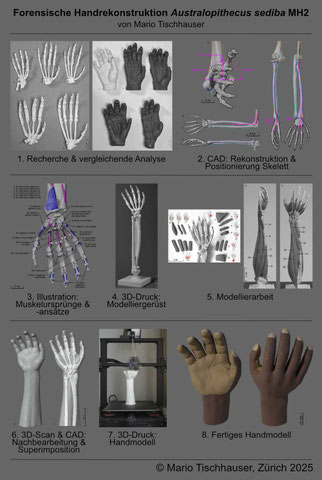
His primary focus lies in the forensic-morphological reconstruction of fossil hominin hands dating from approximately 3.5 million to 40,000 years ago. In this endeavor, he combines scientific precision with sculpting expertise. Grounded in fossil bone discoveries, comparative anatomical studies, and paleoanthropological research, he creates three-dimensional reconstructions that render the form, function, and tool use of early humans comprehensible.
His work unites traditional sculpting techniques with modern processes such as scientific photography, 3D scanning, 3D modeling, and 3D printing. Through a dialogue between analog craftsmanship and digital technology, he develops reconstructions, models, and studies that bridge the gap between scientific research, museum education, and artistic practice.
Furthermore, he explores biological and cultural paleoanthropology centered around the hand and tool use. His lectures and works are dedicated to the evolution of the hand, the emergence of fine motor skills and technology, as well as the cultural significance of human gestures and manual capabilities. Within this framework, the hand appears not only as an anatomical masterpiece but also as the very origin of human creative power.
Positioned between science, craftsmanship, and cultural reflection, he is developing a field of work that reconstructs the past and makes human evolution tangible—in every sense of the word.
Insight Rekonstruction