
KUNST: RED The Bird of Art 2026
Goose Bumps - RED will appear soon...
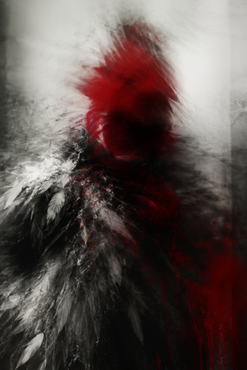
Hinweis: Diese Werkreihe enthält konfrontative und potenziell verstörende Bildmotive.
Diese Inszenierungen sind Teil einer künstlerischen Auseinandersetzung mit Wahrnehmung, Macht und Rollenverteilung und stellen keine Form der Gewaltverherrlichung dar. Die Arbeiten sind nicht uneingeschränkt für alle Altersgruppen geeignet.
Die Haut ist die erste Grenze, die wir bewohnen. Sie trennt uns von der Welt – und verbindet uns zugleich mit ihr. In vielen Kulturen ist die Oberfläche des Körpers kein privater Raum, sondern ein öffentliches Medium: ein Display, auf dem Zugehörigkeit, Macht, Geschlecht, Alter und Begehren sichtbar werden. Die Haut ist nicht nur Biologie, sondern eine soziale Technologie.
Ausgehend von der Ethnographie der Kayapó (Amazonas) beschreibt Terence S. Turner die Körperoberfläche als symbolische Schnittstelle zwischen Individuum und Gesellschaft. Haartracht, Bemalung, Schmuck, Narben, Stoffe und Regalia bilden ein visuelles Vokabular, das soziale Rollen, Übergänge und Hierarchien codiert. Rot markiert Vitalität, Schwarz Transformation und Weiss Neutralität. Haare wachsen wie Kräfte, die gebändigt werden müssen. Schmuck öffnet und verschliesst symbolische Kanäle: Hören, Sprechen, Begehren, Autorität.
Im Ritual kehrt sich die Ordnung um: Natur wird auf die Haut aufgetragen – Federn, Blut, Tiermotive – und erzeugt eine ästhetische Ganzheit, die die Kayapó „Schönheit“ nennen. Diese Schönheit steht im Spannungsfeld zur alltäglichen „Dominanz“, dem Wert der Macht und Hierarchie. Die Haut wird zum Ort, an dem diese Kräfte verhandelt werden.
Turners Konzept steht in einem dichten Netz anthropologischer Resonanzen: Mauss sieht den Körper als Technik; Turner zeigt ihn als semiotisches System. Victor Turner beschreibt Rituale als Transformation; hier wird die Oberfläche selbst transformiert. Douglas versteht Reinheit als Ordnung; die Haut wird zur Membran sozialer Energie. Strathern denkt Personen relational; die Haut wird zum Archiv von Beziehungen. Lévi‑Strauss analysiert Strukturen und Oppositionen; die Haut wird zur Matrix von Natur/Kultur, Innen/Aussen, Passiv/Aktiv.
Die soziale Haut ist ein Modell der Gesellschaft. Ein Ort, an dem intime Kräfte und kollektive Ordnungen ineinandergreifen. Ein lebendiges Diagramm, das zeigt, wie Identität gemacht wird – sichtbar, verhandelbar, verletzlich.
RED The Bird of Art versteht die Haut als politische Oberfläche, als soziale Architektur, als Material der Bedeutung. Es untersucht, wie Körper gestaltet, gelesen, kontrolliert und gefeiert werden – und wie die Oberfläche selbst zu einem Raum wird, in dem Gesellschaft eingeschrieben, überschrieben und neu entworfen wird.
Terence S. Turner ‘The Social Skin’ (1980)
«Man is born naked but is everywhere in clothes (or their symbolic equivalents). We cannot tell how this came to be, but we can say something about why it should be so and what it means.
[...]
As Lord Chesterfield remarked:
Dress is a very foolish thing; and yet it is a very foolish thing for a man not to be well dressed, according to his rank and way of life; and it is so far from being a disparagement to any man’s understanding, that it is rather a proof of it, to be as well dressed as those whom he lives with: the difference in this case, between a man of sense and a fop, is, that the fop values himself upon his dress; and the man of sense laughs at it, at the same time that he knows that he must not neglect it (cited in Bell 1949, p. 13).
[...]
The first point that should be made about Kayapo notions of propriety in bodily appearance is the importance of cleanliness. All Kayapo bathe at least once a day. To be dirty, and especially to allow traces of meat, blood or other animal substances or food to remain on the skin, is considered not merely slovenly or dirty but actively anti-social. It is, moreover, dangerous to the health of the unwashed person. ‘Health’ is conceived as a state of full and proper integration into the social world, while illness is conceived in terms of the encroachment of natural, and particularly animal forces upon the domain of social relations. Cleanliness, as the removal of all ‘natural’ excrescence from the surface of the body, is thus the essential first step in ‘socialising’ the interface between self and society, embodied in concrete terms by the skin. The removal of facial and bodily hair carries out this same fundamental principle of transforming the skin from a mere ‘natural’ envelope of the physical body into a sort of social filter, able to contain within a social form the biological forces and libidinal energies that lie beneath.
[...]
The connection of ‘beauty’ with ‘wealth’ in the form of bodily adornment is strikingly expressed in the lyrics of the choral hymns sung by the massed ritual celebrants as they dance, with uniform steps which vary with each song, the successive rites that constitute a ‘great’ or ‘beautiful’ naming ceremony. These songs are almost invariably those of animals, especially birds, the muses of Kayapo lyric and dance, who have communicated them to humans in various ways. Two verses from the vast Kayapo repertoire may serve as examples. A bird proudly boasts to his human listener,
Can we [birds] not reach up to the sky?
Why, we can snatch the very clouds,
Wind them round our legs as bracelets,
And sit thus, regaled by their thunder.
Another calls out a stirring summons to earthbound humanity:
I fly among the branches [rays] of the sun;
I fly among the branches of the sun.
I perch on its branches and
Sit gazing over the whole world.
Throw yourselves into the sky beside me!
Throw yourselves into the sky beside me!
Cover yourselves with the blood and feathers of birds
And follow after me!
The admonition about blood and feathers refers to the technique of covering the body of a dancer with his or her own blood, which is then used as an adhesive to which the breast plumage or down of macaws, vultures or eagles is fixed. This is perhaps the most prestigious (‘beautiful’) form of sacred costume. These verses may help one to grasp the connotations of the fact that dancing (and by extension, the celebration of any ritual) is called ‘flying’ in Kayapo, and of the term for the most common item of ceremonial adornment, the feather head-dress, which is the ritual form of the word for ‘bird’.
Birds fly, and ‘can scan’ the whole world. They are not confined by its divisions, but transcend them in a way that to a Kayapo seems the supreme natural metaphor for the direct experience of totality, the integration of the self through the perception of the wholeness of the world. This principle of wholeness, the transcendental integration of what ordinary human (that is, social) life separates and puts at odds, is the essence of the Kayapo notion of ‘beauty’.
[...]
That the physical surface of the human body is systematically modified in all human societies so as to conflate these three levels of relations (which most modern social science devotes itself to separating and treating in mutual isolation), should give us cause for reflection. Are we dealing here with a mere exotic phenomenon, a primitive expression of human society at a relatively undifferenti-ated level of development, or is our own code of dress and grooming a cultural device of the same type?»